
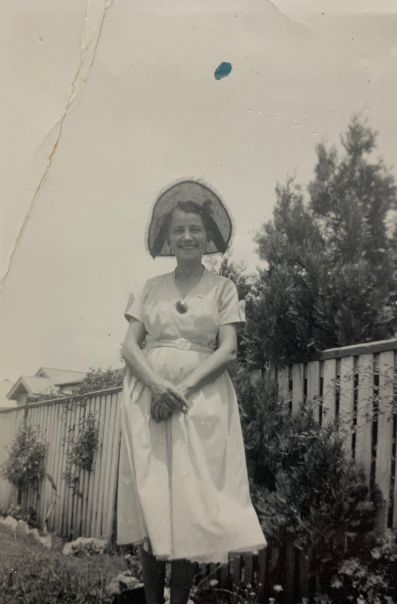
-
Birth name
Jessie Craig
-
Place of Birth
Glasgow, Scotland
-
Place of Death
Regina Caeli Catholic Church
Early Life and Education
Born in Scotland
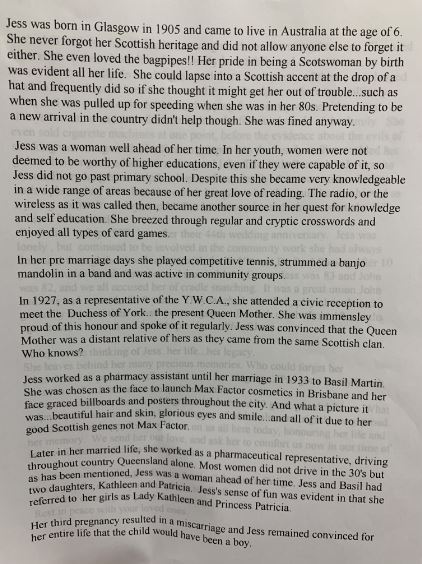
Jessie Colquhoun Craig was a child of spring. A fitting season indeed for a woman who would maintain a lifelong love of growing flowers. Born on the 22nd of April 1905 in Glasgow, Scotland, Jess was the third child of Mary Falconer Drummond and John Craig. She had an elder brother, Andrew Craig, born 1901, and an elder sister, Isabella Craig, born 1903, also known as “Isa”. Joan Craig, the youngest sibling, arrived later on.
Jess’s mother, Mary Drummond, was Glasgow born and bred. She married John Craig at the age of 20, though her father did not at all approve of the marriage. He was perhaps not so wrong to resent the union, as John would prove to be a rather questionable husband. But at the time his main concern was his daughter marrying below her class. John did not come from money, while Mary’s own family was quite wealthy. Despite this, the couple wed in 1901 and had their first child, Andrew, the same year. They spent the first decade of the 20th century raising a family in the Scottish neighbourhood of Kelvingrove. Mary’s family did not offer any support, essentially disowning her. John remained a man of humble means, working as a boilermaker and journeyman on the wharfs of Glasgow.
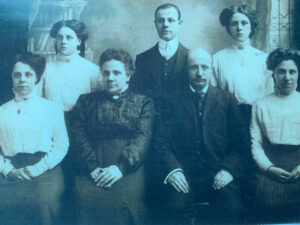
A Boat to Australia
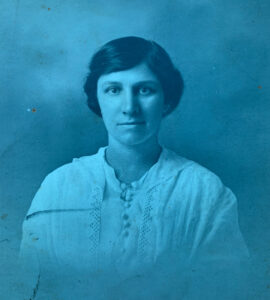
When Jess was almost 6 years old, her family left Scotland on a boat. John Craig’s older brother had migrated to New Zealand during the 1880s-90s, and worked on a sizeable sheep property, which he inherited from the owner after his death. In Jessie’s own records of family history, she describes her uncle writing to John Craig and his extended relatives, “painting a glowing picture of life in New Zealand and inviting him and the rest of the family with their children to migrate at his expense, to join him”. This was when Mary was still pregnant with Jess, so they did not travel with the rest of the Craig family. They instead waited a few years before heading off in search of new opportunities. It was 1911 when Mary, John and their three children embarked on a seaborne journey to the southern hemisphere, travelling aboard the Millidies.
Though she was only young when they left Scotland, Jess never lost her memories of time at sea. The trip was long, exhaustingly long, around 6-8 weeks living on a boat in what were likely very low levels of luxury. She was often quite scared. Portholes, in particular, were a source of terrible fear. She had heard somewhere or other, presumably from her parents, a story about a baby who fell through a porthole and was lost to the sea. She thus avoided them at all costs.
The family eventually disembarked in Brisbane, supposedly be a mere stopover on the way to New Zealand. Mary, however, had spent the months suffering from seasickness, and decided enough was enough. She declared she was never getting on another ship again, thank you very much! Plans for New Zealand fell away and Brisbane, instead, was to become their new Australian home.
Jess stayed connected to her heritage throughout her life, and was a proud Scotswoman. Though she lived in Brisbane from the age of 6, Jess always referred to herself as Scottish, not Australian. She developed an Australian accent as she grew older, but at home the family all spoke in a thick Glasgow brogue.
Settling in Brisbane
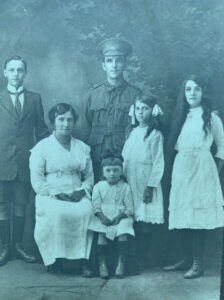
The Craig family settled in the suburb of Kelvin Grove. Perhaps the familiar name drew them towards the area, having lived already in Kelvingrove back in Glasgow. It would have been a source of comfort, something familiar amidst all the unknowns of migrating to a new country. Mary was very soon pregnant again with Joan Craig, who was born in 1912. Their youngest child, and Jess’s little sister.
Jess was enrolled in Newmarket State School, along with her elder siblings. A couple of years into schooling, World War 1 broke out. The “war effort” would have been a constant theme for Jess, both at school and at home. As an older woman, she did not share much about her first war experience, but certainly it would have been a life of scarcity. The family were still fairly new to Australia, with little money, and this would have been amplified by shortages in food and clothing.
A Tough Childhood
Jess’s childhood years even post world war one were difficult. Home wasn’t a peaceful place. John Craig, her father, was prone to violent bursts of anger, and would often throw things. He never hit Mary nor any of the children, but they lived at the whim of his temper.
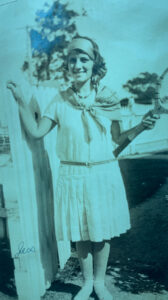
There are a few contradicting stories about the end of John and Mary’s marriage. It is possible that John ran off upon arrival to Australia, though it seems unfathomable that Mary could have raised four children by herself. It is also possible that Mary waited until the three eldest children (Andrew, Isa and Jess) were old enough to work and offer financial support themselves, and then kicked John out of the house, no longer able to stand for his violence. And it is thirdly possible that John himself waited until the children were this age, decided he had adequately fulfilled his role as a father, and ran off then. Whichever of these was true, it is nevertheless certain that by the time Jess was 14, her parents were divorced, and she no longer had a father present in her life. John Craig was cut off from the family, who told everyone thereafter that he was dead. Jess’s father only turned up again in her life once, very many years later, during her engagement to Basil Martin, who encountered his soon to be father-in-law in a store in Murroree (scroll to “Marriage to Basil Martin” to read the whole story).
Divorce was still quite uncommon during the 20s, especially for a Scottish Presbyterian family. With Mary as a single mother, the situation was quite unusual. Jess, Isa and Andrew were thrown into the responsibility of financially supporting their household. Jess in particular had only just graduated primary school, and went straight to work at the young age of 14. Girls simply did not continue on to higher education during the early 20th century, so this marked the end of Jess’s school days. She had a short childhood. Taking on the burden of regular wage would have been an enormous responsibility for such a young girl, and likely had a great influence on Jess’s awareness of waste in later life. Growing up through the war, and then being exposed so early to the harsh realities of money… this must have programmed Jess to make use of every resource, to always be saving a dollar here and there. As an adult, she had a very strong anti-waste mentality, always mending things and recycling seemingly useless materials to find them a new function. She was able to sustain a tight household in what were often very scarce conditions and had a knack for entrepreneurial projects that could bring in some extra income.
Blossoming
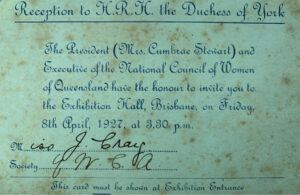
Despite living in quite tough conditions for most of her life, Jess always understood the power of presentation. She knew she was a capable and independent woman and did not like others to see her struggle. She was consistently well-dressed, and took care to cultivate her intellect. In her later teenage years, though Jess was no longer being officially schooled, her curiosity, intelligence, and love for reading anything and everything allowed her to continue her self-education. She listened to the wireless, absorbing the goings on of the world. She liked challenging her brain with complicated cross words and playing all sorts of card games.
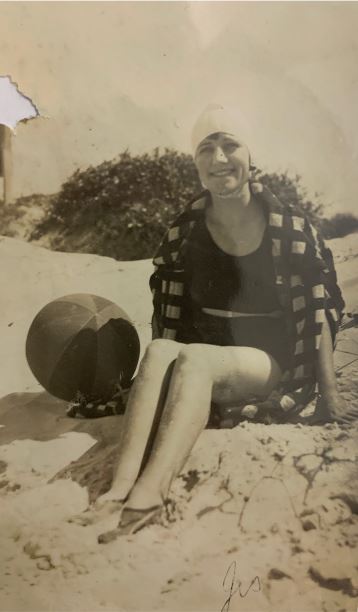
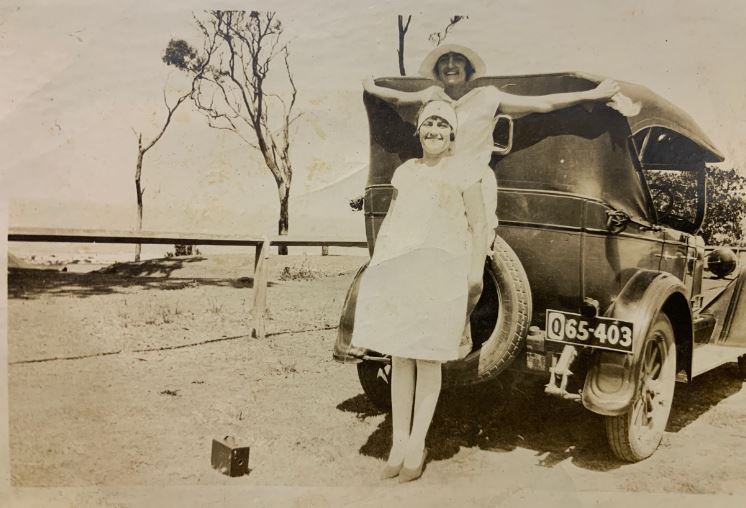
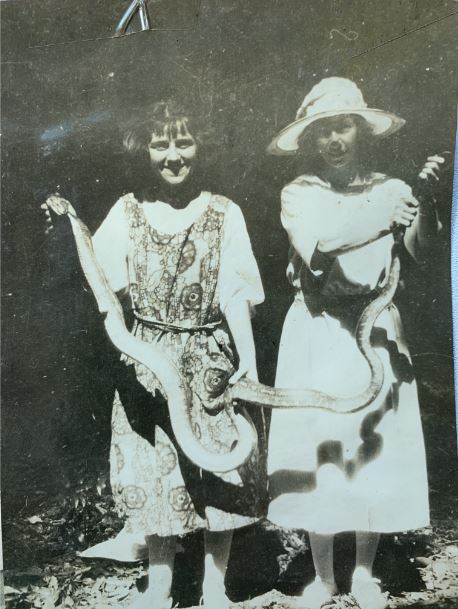
Jess remained involved in many dimensions of community as she blossomed into a young woman. She played competitive tennis, and had a little stretch in a band, playing the banjo mandolin. Despite her busy work schedule, she was also active in community groups, always of a vibrant, social disposure, with a selfless willingness to do good for others that followed her to old age. In 1927, as a representative of the Y.W.C.A (Young Women’s Christian Association), Jess had the honour of attending a civic reception to meet the Duchess of York, Elizabeth the Queen Mother. She was very proud of this opportunity. Jess was rather convinced that the Queen Mother was a distant relative of hers, as they came from the same Scottish clan.
Pharmacy
Early employment
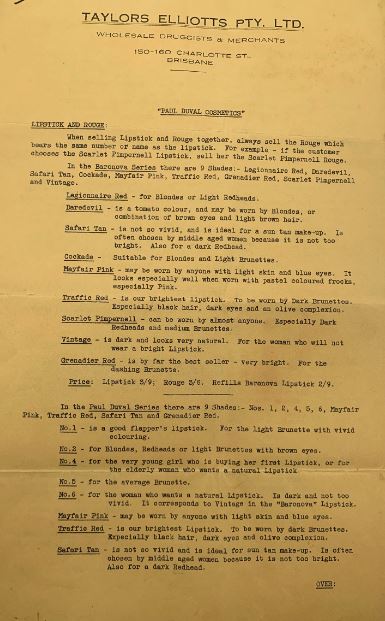
Jess was employed as a pharmacy assistant from when she finished school. She started out working behind the counter, but eventually took on a management role. She had a charming personality, and could sell anything. It was an era when chemists were the go-to hub for make-up and beauty products, so a lot of her job involved a vast knowledge of lotions, creams, lipsticks and rouges. She had to understand their application, and have a certain sensitivity to skin types and skin tones, to what products would suit whom.
Bill Edwards
In 1930, Charles Augustus Edwards (“Bill”) opened a pharmacy in Brisbane city. He became Jess’s employer. Jess was always awfully proud to work for “Big Bill Edwards”, as he was locally known. He was recognised in the tennis world, having been a competitive player himself, and later went on to be president of the Queensland Lawn Tennis Association and the Lawn Tennis Association of Australia. “Bill” was the name he chose for himself, and “Big” was added on by public opinion. He was a very large man, tall and heavy. Bill Edwards stayed connected to Jess even after her employment. While still working at the chemist, Jess started seeing Basil Martin, her husband-to-be. Bill and Basil became good friends, and Bill went on to be the best man at Jess’s wedding. Bill also met the dressmaker Ruth Henrietta Barr through Jess, who was the woman he would marry.
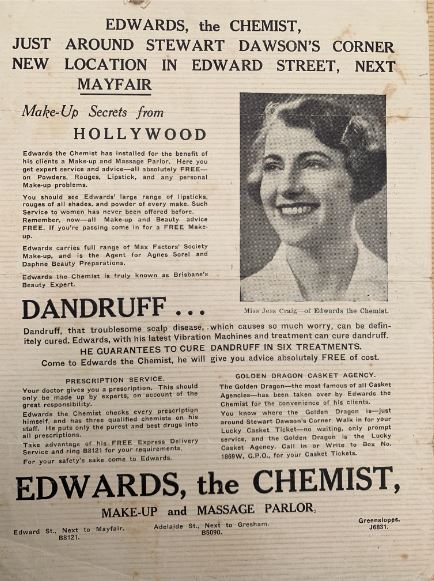
It was during her time in Big Bill’s employment that Jess was chosen as the face to launch Max Factor cosmetics in Brisbane. Jess certainly had an attractive appearance, with a sparkling smile that filled her eyes, and glowing Scottish skin. Her picture was blown up on billboards and advertisement posters all around the city. “Edwards the Chemist is truly known as Brisbane’s Beauty Expert,” read the advertisement next to Jess’s smiling face.
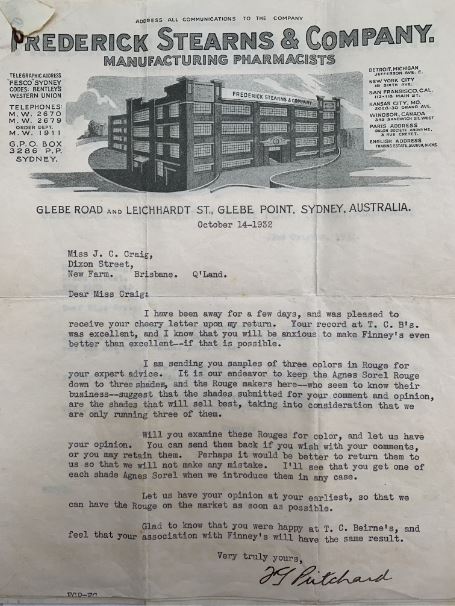
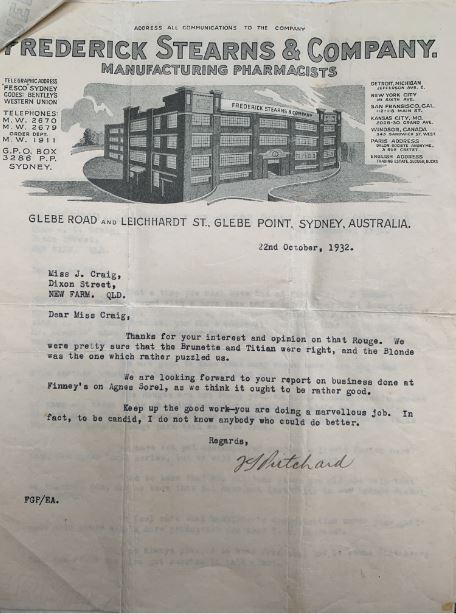
Jess worked also for Frederick Stearns & Company, a larger cooperation with offices based in Sydney that Edward’s the Chemist belonged to. She travelled to various chemists to demonstrate products and was praised wherever she’d go. In letters of correspondence to Sydney discussing her weeks working at Finney’s, McWhirter’s and T.C. Beirne’s, someone by the name of Pritchard writes “keep up the good work – you are doing a marvellous job. In fact, to be candid, I do not know anybody who could do better.” T.C. Beirne’s, one of these various chemist stores, adored Jess so much they wanted her to stay on permanently, and name her own salary. But she had promised Bill Edwards she would return, and loyalty sent her back to her home store.
Taylors and Elliotts
Jess continued pharmacy work in her early married life. Her husband headed west in search of employment in the late 30s, and Jess started working as a pharmaceutical representative for Taylors and Elliotts, driving around rural Queensland selling products. It was uncommon for woman to drive during this era; this was Jess’s independent streak coming into play.
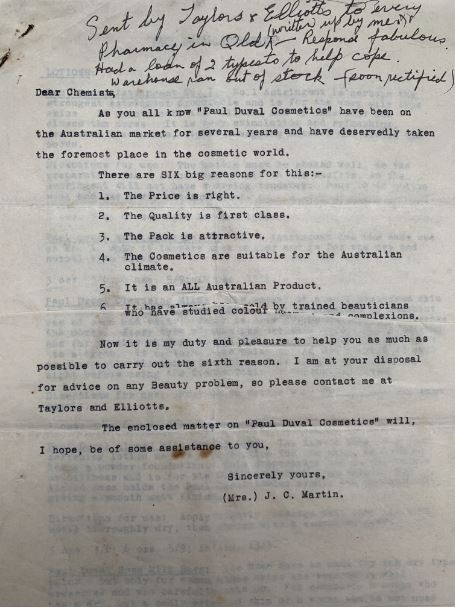
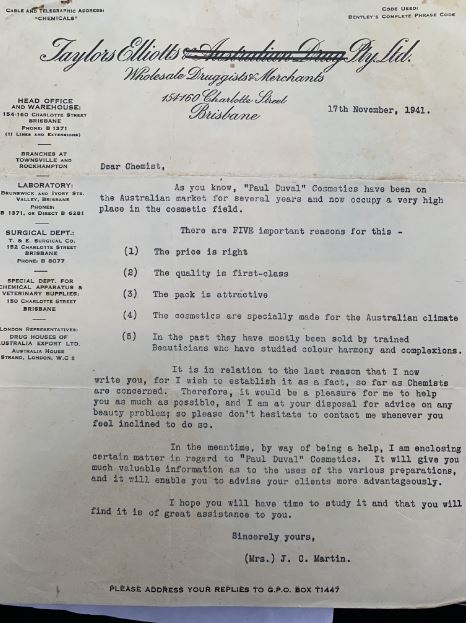
While working for Taylors and Elliotts, Jess wrote a lot of letters out to chemists advertising products, signing them as Mrs J.C. Martin, her married name. In a letter regarding “Paul Duval Cosmetics”, Jess writes: “As you all know “Paul Duval Cosmetics” have been on the Australian market for several years and have deservedly taken the foremost place in the cosmetic world. There are six big reasons for this: –
- The Price is right.
- The Quality is first class.
- The Pack is attractive.
- The Cosmetics are suitable for the Australian climate.
- It is an ALL Australian Product.
- It has always been sold by trained beauticians who have studied colour harmony and complexions.
Now it is my duty and pleasure to help you as much as possible to carry out the sixth reason. I am at your disposal for advice on any Beauty problem, so please contact me at Taylors and Elliotts…”
Documents
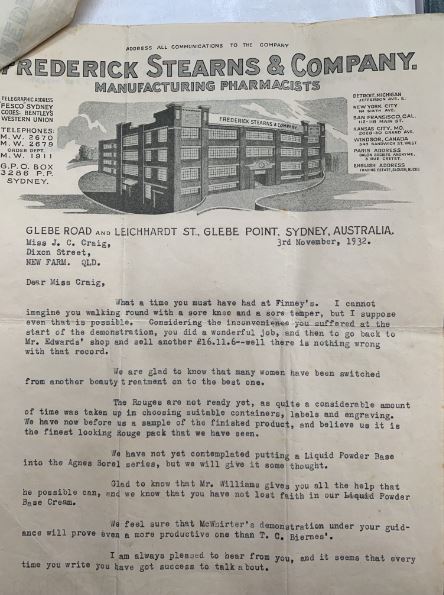
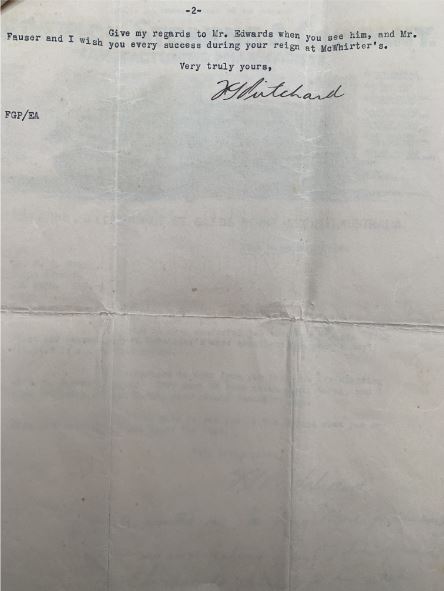
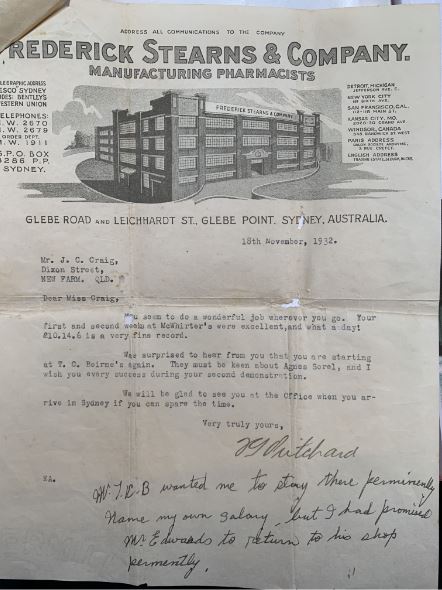
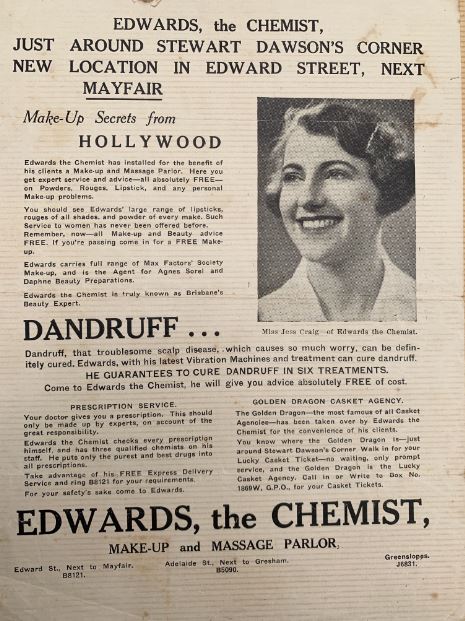
Marriage to Basil Martin
The Beginning
It is uncertain how exactly Jess met Basil Martin. A likely possibility is that he walked into the chemist while she was at work, and from there a connection was born. Regardless, the couple started seeing each other in the early 1930s.
Basil Martin was born in Rutherglen, Victoria, in 1902. His mother was Irish, and he was one of six children. He was the second youngest child, just like Jess. He was a tall, broad man, with one leg thinner than the other from polio as a child, which gave him a limp. They were quite the striking couple, for Jess herself was a tiny woman. Basil was working as a real-estate agent at the time he met Jess – he too had a charming personality.
When Jess first took him to visit her family home, everyone was chatting away in strong Glasgow accents, Jess herself included. Basil was quiet, not saying a word. This silence was rather out of character, for he was ordinarily a very chatty man. Jess asked what was wrong with him, and Basil replied, “I haven’t understood a bloody word since I got here!”
An extraordinary coincidence also allowed Basil to meet Jess’s estranged father, John Craig. Basil was away from Brisbane, in the town of Murroree, where he went into a store to purchase cigarettes. As was commonplace to the era, the store had a sign with the name of the owner out the front – this particular store was owned by a “John Craig”. Basil made the passing comment over the counter that he was “engaged to a girl named Jessie Craig”, for of course it was the same surname. The store’s owner proceeded to ask him if this girl’s mother was Mary, if her siblings were Andrew and Isa, informing Basil that Jessie was in fact his daughter. Basil knew little of Jess’s father, for the family had lied and said he was dead, presumably to avoid the difficult topic of divorce. This would be the first and last time he would meet his father-in-law, who was never in contact with the family again.
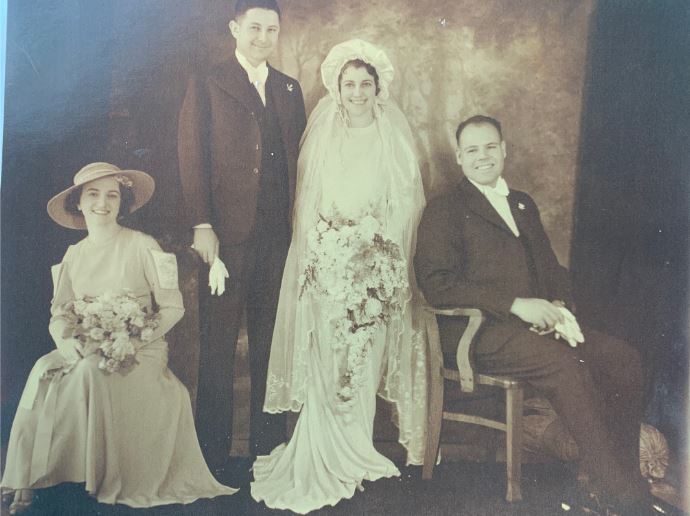
Basil and Jess were married at the Holy Spirit Catholic Church of New Farm in 1934, when Jess was 29. Basil’s family was Irish Catholic, while Jess, on the other hand, grew up Scottish Presbyterian. Jess had to convert to Catholicism before their wedding, going through the sacraments. Bill Edwards, Jess’s boss, offered to pay for her wedding dress, as a wedding present. She asked around to seek out the best dressmaker in Brisbane, and was pointed towards a woman named Ruth Henrietta Barr. Jess was concerned that Bill had not comprehended quite how much a wedding dress would cost, and during their first meeting she expressed this to Ruth. Ruth offered to contact Bill Edwards to sought out the financial business of the dress herself. Jess would not have to worry about a thing. She did so, and later that year Ruth Barr and Bill Edwards married themselves.
A New Family
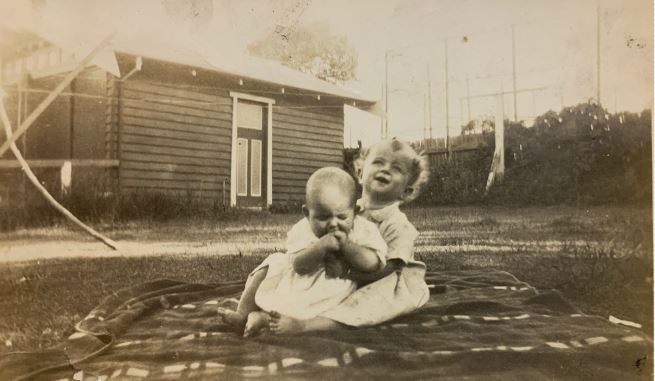
Jess and Basil moved into the Brisbane suburb of Dutton Park. They gave birth to their first daughter in 1935, Kathleen Theresa Martin (“Kathy”). Jess chose the name Kathleen, unaware at the time that it was also the name of Basil’s younger sister, who went by the nickname “Babe”. Jess was not a fan of Basil’s sisters generally, but she especially disliked Babe, and was rather disgruntled when the correspondence between names was pointed out. Their second daughter, Patricia Joan Martin, also known as “Tricia”, was born in 1937. Both daughters were baptised as Catholic. There was a third pregnancy, a child Jess was convinced would have been a boy, but it sadly ended in miscarriage.
These first few years were prosperous for the young Martin family. They were able to afford household help, and even a gardener. When she was of age, Kathleen was enrolled at St Ita’s Catholic Primary School.
The Split
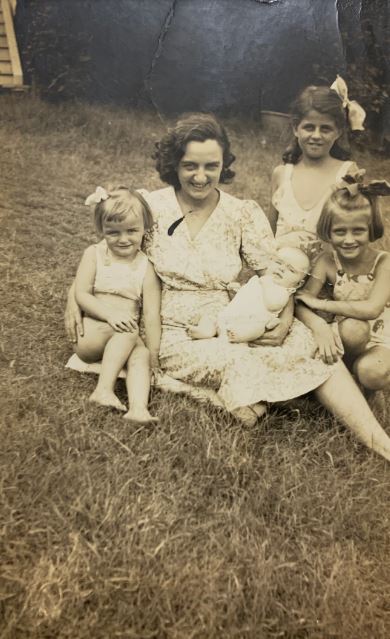
Basil got himself into some kind of financial mess when Tricia was about 3 years old, and Kathy was just starting school. He left home to head west, in search of a job and income to support the family. The plan was for him to send money home, but as time passed, no money arrived. Jess was alone with two little girls.
To compensate for Basil’s absence, Jess found employment with Taylors and Elliotts, as a travelling pharmaceutical representative. Her job required her to be constantly on the road, and she was unable to be around to care for and supervise her daughters. She did not turn to her mother nor her siblings for assistance, choosing instead to keep the situation to herself. She left Tricia and Kathleen in the care of Nudgee Orphanage, though this stay did not last very long. A few weeks in, Tricia wet the bed, and Kathy was ordered to wash her sister’s sheets. Of course, as a five-year-old, this was a job she had never done in her life. Kathy ran away from the orphanage, or she tried to, at least. She fell over and cut her leg, a wound from which she still has the scar today. It was very soon after this incident that Jess’s younger sister, Joan, found out that the girls were in an institution. She was furious and insisted that they come live with her and her husband Leslie Smollen in Toowong, despite already having three children of their own. Jess consented to this, though by this point she had no choice. Her resistance to seek support speaks to a particular pride Jess carried throughout her life – to ask for help was to admit weakness, an inability to keep up in tough conditions that Jess would have seen as a failure.
Failing to send money home, Basil signed up to the army with the outbreak of World War 2. He was accepted, despite being physically handicapped. He was sharp with numbers, and was stationed at Harristown on the outskirts of Toowoomba, doing clerical work. Jess soon ended her pharmacy employment, and moved with the girls to Toowoomba due to a foot injury of Tricia’s, as well as to be close to Basil (see “Motherhood in Toowoomba: Tricia’s Foot”). This would be the family’s home town for the next fifteen nears.
Post-War Parenting
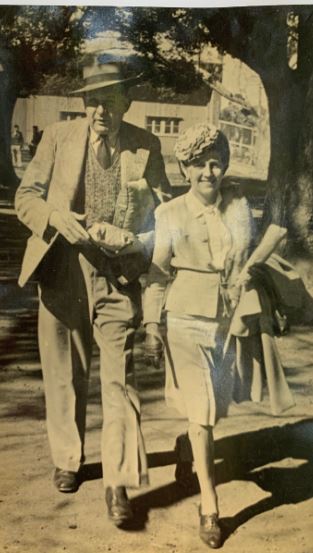
After the war, the family was reunited, and lived at 12 Gostwick St, a house they stayed in for the rest of their time in Toowoomba. Basil started up work again in real estate, opening a business and office in town. Though Jess was not officially employed, she was not the kind of woman to stick to the borders of the domestic realm. She frequently visited Basil’s office, where she helped him in his business and dealt with paperwork and finances. Eventually Basil’s regular trips to the pub with clients started to affect the business, and they sold before it fell apart (see “Basil’s drinking”). Basil then went to work for the Toowoomba sector of a motoring firm called Eagers, where he worked as a costing clerk. Jess maintained various entrepreneurial side projects to earn them some extra money.
Things were financially tight for most of the Toowoomba years. Basil and Jess raised their girls in a humble, hardworking household, which was in many ways self-sustained. Jess sewed all of the family’s clothes, and they ate fresh produce from Basil’s vegetable patch, eggs from the chicken coup in the back garden. The girls were educated for free at local Catholic schools. They had no car, and would rarely take family holidays, except for the occasional beach trip to Coolangatta. Christmas was an intimate affair, with immediate family only. Sometimes Jess’s mother Mary would join them from Brisbane.
For the most part, Basil and Jess had a fairly harmonious relationship. They bonded over a love of gardening, and Jess always had a soft spot for Basil’s music (see “Music”). They were both avid readers, and raised their daughters in the same vein – in a household with no TV, family evenings were spent sitting by a burning stove, reading. Raising two little girls did not require from them particularly strenuous parenting.
Though both parents were extraverted, charming people, they had few significant family friends. They kept contact with Jess’s old boss, Bill Edwards, who lived in Brisbane. Basil had a close friendship with a priest, Brian O’Dwyer, with whom he would drink rum out on the porch at sunset, chatting away. But for the most part the household hosted few guests, other than the local children who came to play with Tricia and Kathy. Their lack of friendships was perhaps a symptom of an era with few technological mediums for social contact, such as phones and cars. It was likely also a side effect of being newcomers in a community much smaller than Brisbane, and of raising a family in harsh financial conditions.
Music
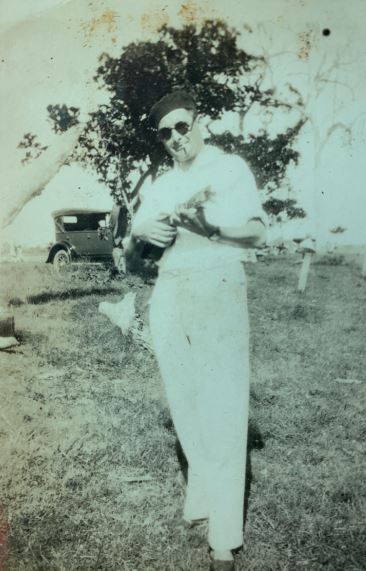
Basil was a musical man, and came from a family of talented musicians. He himself played the ukulele and the harmonica, or the “mouth-organ” as it was known then. He had a wonderful musical ear, and could pick up all sorts of songs simply by listening. Prior to meeting Jess, he had played on street corners with his brother Jack, where strangers passing by would often invite them to house parties to perform. This musicality was likely part of the reason Jess was drawn to Basil. Though she was of no significant talent herself, she always loved to sing and dance. In later years, after Basil’s death, his music was a key point of reminiscence.
Basil’s musicality was passed down to his daughters. Upon moving to Toowoomba, Jess insisted Kathy and Tricia take piano lessons at the convent, taught by nuns. There was a pianola in the household’s living area, where the girls would practise. Kathy played both the violin and the piano, and completed all of her piano exams to the highest level. Tricia stopped lessons early on, but always had a musical ear, and would teach herself songs on the pianola. Sometimes Basil and the girls would play songs, and Jess would listen, or even dance. She especially loved to sing the song “I’ve got a lovely bunch of coconuts”, which Tricia played on the pianola.
Basil’s drinking
The one significant source of conflict in Jess and Basil’s marriage was alcohol. Basil drank and Jess didn’t, at this stage of her life at least (see “Budd’s Beach: Spritely as can be”). This was possibly for religious reasons, or perhaps being of an era that viewed drinking as “unladylike”. Regardless, Jess disapproved of Basil’s regular stints at the pub. In their early years of marriage, in Brisbane, Basil’s drinking habits were most likely the main source of the financial mess that required him to leave his wife and two young daughters, to go seek employment out west. It remains unclear today to what extent this split was also a temporary split in the relationship.
In Toowoomba, post-WW2, a typical day at work for Basil involved taking a client out to see a property, and then heading straight to the hotel pub afterwards, to celebrate the end of the day. When he came home in the evening quite inebriated, Jess would roar at him for walking into the house in such a state. Her demeanour was usually quite calm, and this was the only time her daughters remember her being angry. For a very small woman, she could certainly be fierce. But despite Jess’s best efforts, Basil’s drinking continued. The real estate agency suffered from his alcohol habits, which threatened to yet again be the family’s financial downfall. The business had to be sold.
Later Years
After their daughters graduated from school, there was no longer anything tying Jess and Basil to Toowoomba. Kathy and Tricia were both living in Brisbane, attending college and training as teachers. Jess and Basil returned to the city as well during the 50s, moving into 7 Livingston St, Yeerongpilly. There was enough room in the house for Kathy and Tricia to move in while they finished their studies. It was during these Brisbane years that both daughters were married. Tricia’s wedding reception took place in the Yeerongpilly home (see “The Next Generation: Weddings”).
In Brisbane, Basil continued to work for the motoring firm Eagers, transferring to the Brisbane headquarters. No longer a full-time mother, Jess continued to keep herself busy, gardening and sewing millinery for a store in town. It was a happy, peaceful time for the couple, who were now free from the financial responsibility of raising children, and secure in their employment. They went on regular holidays to the coast, where Basil loved to go fishing. They became grandparents, and remained connected with family.
During the late 60s, Basil suffered from a stroke, and was no longer able to work. The couple travelled back and forth between Brisbane and holidays at the coast. Noticing Basil’s health improve at the seaside, Jess began to search for residency in a coastal suburb, as well as employment for herself. She saw an advertisement seeking a live in carer for an elderly man in Labrador, Mr Elphinstone, and successfully applied for the job. Jess and Basil moved to the coast, living in a self-contained half of Mr Elphinstone’s home on Stoke Lane. Jess tended to his garden and drove his car, buying him any needed supplies.
With the financial support of their daughters, Jess and Basil remained at Stoke Lane after Mr Elphinstone’s death, and lived there throughout the 70s. Tricia and her husband John bought the property, while Kathy and her husband Warwick bought the couple a car and paid for their telephone bill. Basil’s health inevitably continued to dwindle. He suffered a second stroke and was admitted to hospital, where he passed away in September 1977, at the age of 75, just after their 44th wedding anniversary. The death of her husband did not cause any obvious change in Jess, who’s grief was not apparent to those close to her. She moved out of Stoke Lane at the earliest opportunity, selling the property herself without informing her family. Perhaps the house was haunted by the memory of Basil, or perhaps she was simply restless and liberated, ready to move on with a new chapter of her life. Jess’s lifelong resistance to exposing her sufferings make it difficult to know the full emotional impact of her partner’s death.
Motherhood in Toowoomba
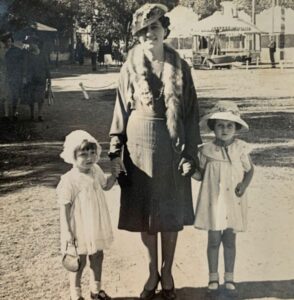
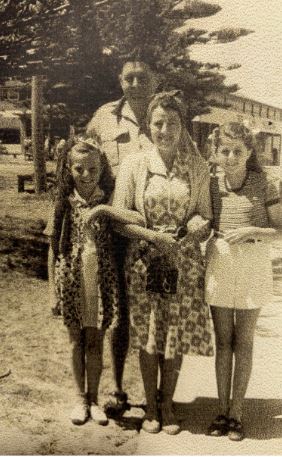
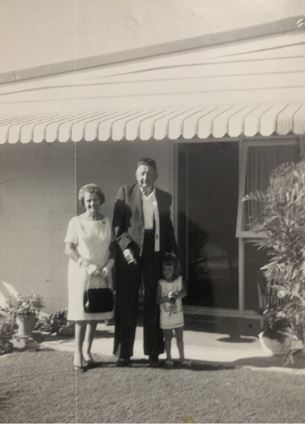
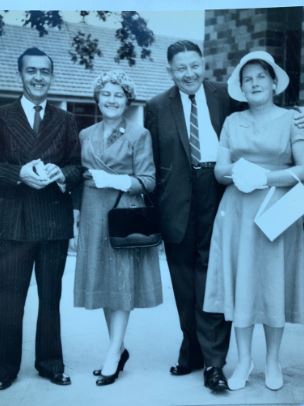
Jess possessed a rather impressive array of maternal virtues. She was practical, efficient, and capable of managing multiple responsibilities at once. It was in her nature to be perpetually busy. She was tender and caring towards her daughters, Kathy and Tricia, and would kiss them before bed every night. She made sure they were dressed in beautiful homemade clothes, and that they always had a birthday party under their Toowoomba family home, with a cake and candles. She remained steadfast during tough times; her aversion to waste assisted her in sustaining a household when money was low. Jess was determined to give her girls as many opportunities as possible. She ensured they learn musical instruments and apply themselves to their studies. She never stopped working hard – at home, in the Toowoomba community, in Basil’s real-estate business – and yet at the same time she was chatty and full of spirit. Jess never shared much about her own childhood, but perhaps she wanted to give her children the prosperity and education she never had.
Though the family lived in Brisbane in the early years, Jess’s years of motherhood primarily took place in Toowoomba, where she moved to from Brisbane in the early 40s.
Tricia’s foot
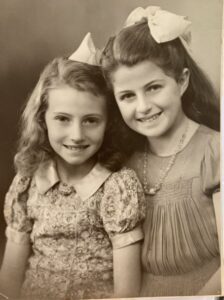
The move to Toowoomba was triggered by a medical urgency. Jess’s youngest daughter, Tricia acquired a new pair of sandals while she was living in the care of Jess’s sister, Joan, and her husband Leslie Smollen (“Uncle Les”). They were brown leather, with a strap that rubbed the skin on the back of her ankle. What started as a deep blister blew up into a terrible infection, for the dye from the sandals poisoned the wound. “I remember Uncle Les taking me to the Mater hospital and I looked up and saw a statue of Mary and asked Uncle Les if that was an angel”, writes Tricia. She had what we now call septicaemia, usually treated with penicillin antibiotics, however these were not a medical option in 1940. Tricia was in hospital for multiple weeks while she recovered. Jess returned to Brisbane to visit her three-year-old daughter, gifting her a big cardboard dollhouse with figures and furniture inside. The nuns, however, placed the dollhouse in the middle of the ward, and would not let Tricia play with it. After Jess’s visits, Tricia would become so distraught that the hospital eventually instructed her mother to stay away.
Upon being discharged from the hospital, doctor’s orders were to relocate Tricia to somewhere with mountain air, to help her infected foot heal. The choice was between Tamborine or Toowoomba. Basil happened to be stationed with the army in Wallangarra at the time, for he had signed up with the outbreak of World War 2. Toowoomba was the closer option, so this was where Jess moved her life and her two little girls. Basil eventually would later be posted to Harristown, on the outskirts of Toowoomba, until he was reunited with the family after the war.
Residency
In Toowoomba, Jess initially moved into Rutlands, a boarding house on Margaret Street. Jess and her daughters then rented the upstairs of a house owned by the Dents, where they boarded for about a year. The house was a lovely old property on West St, and is today heritage listed. Pa Dent was the manager of the National Mutual in Toowoomba, quite a wealthy man. His sister Doris was, according to Kathleen, “an old maid in every sense of the word.” A single mother with two little girls, Jess and her daughters were the perfect tenants, for they were quiet, hardly a nuisance to have hanging around. Jess did have a certain resentment towards her landlords, for some now unknown reason. Kathleen recalls Jess encouraging her daughters to learn musical instruments partly to annoy the Dents.
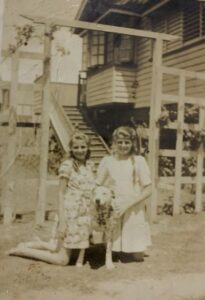
Eventually the family moved into 12 Gostwick St, which would become their home for many years. 12 Gostwick St was one of the first housing commission houses ever built in Toowoomba. The address was close to the hospital, in case Tricia needed medical help for her foot. It was a two-storey weatherboard house, brown with white trimmings. There was a front garden and a back garden, two bedrooms and an outhouse on the back porch. The family eventually had sewerage installed upstairs.
The house also featured a veranda, which Jess had closed in with louvres to create an extra room. This was Jess’s sewing room, and in the summer it became Kathy’s bedroom, earning the nickname of “the sleepout”. In the winter Kathy shared Tricia’s room, where the sisters slept side by side in a double bed. Underneath the main house was a sort of cubby house, storage area, high enough for a car to park beneath the property. The area was an ideal place for the girls to play, and they would often host gatherings of local children from the Toowoomba neighbourhood.
War years
When she first moved to Toowoomba, Jess was essentially a single mother. It was during the war, and an absent father was common, so the family wouldn’t have raised any eyebrows in their community. Jess found employment working at her elder brother’s store. Andrew Craig was already living in Toowoomba with his wife Elma and their dull but intelligent son, Dudley. His wife was from a well-off Jewish family who owned a store named Stuart’s the Suit Specialist in Queen St, Brisbane. When Andrew and Elma married, they opened a Stuart’s in Toowoomba. Jess was lucky to have a family connection in her new community, and this employment was just enough to sustain herself and the girls during the bare war days.
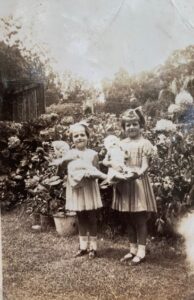
Jess’s youngest, Tricia, had a job at the local grocery run by Mr Boland. All the family’s had coupon ration books during the war, and Mr Boland would swap coupons between families, depending on the specific products they needed. Working at the grocery store had its benefits, as she was sometimes able to bring extra supplies home to Jess.
The family had various encounters with soldiers over the years, a constant reminder of the continuing war. In the earliest Toowoomba days, while Jess and her daughters were living at Rutlands boarding house, their residency was opposite Queen’s Park, where the American soldiers were based. Kathy and Tricia used to wander over to talk to the Americans, and were given sticks of spearmint chewing gum, a treat they had not encountered before.
In later years, when the family were living at Gostwick St, Basil would often bring home soldiers whose families lived far away, and did not have anywhere to stay on their days off. He would come rolling down the road leading a parade of pushbikes, each of them with a soldier on the back and another on the handlebars. They would be welcomed in for a meal cooked by Jess and a floor on which to sleep. It was common to wake up in the morning and step over four or five sleeping soldiers before reaching the kitchen.
The end of the war was celebrated with a big party in Toowoomba. The family went along to see the festivities, as it was at the local Glennie school, located just around the corner. The victory celebrations brought out people from all corners of town, an entire cow was roasted on a spit, and an American soldier heaved Tricia onto his shoulders, carrying her around. Jess lost sight of them in all the chaos, and was frantic until her daughter was found.
Catholic boarding school
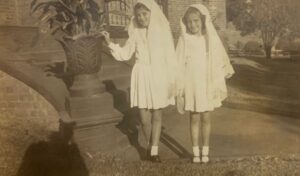
Upon first arrival to Toowoomba, Jess enrolled Tricia at South Girls and Infants School, and Kathy at the North State School, a public education institution. At the same time, she had Kathy regularly attending music lessons at the convent, where she was taught piano by the nuns. Somehow, it was soon brought to the surface that Kathy and Tricia were indeed Catholic. The nuns offered for the girls to be educated at the private Catholic school, St Saviour’s Convent, free of charge. “One week we were standing on the streets singing state school, state school, ring the bell, while the convent march to hell, and the next we were on the other side of the street singing convent, convent, ring the bell, while the state school march to hell,” Tricia recalls.
The girls attended St Saviour’s Convent for many years, until Kathy moved to St Ursula’s Convent for her secondary schooling. She was a boarding student at St Ursula’s, while Tricia remained living at home, attending St Saviour’s. Jess would often visit Kathy with little care packages, for she was still living nearby. Sunday was Kathy’s day at home, and Tricia would cycle to St Ursula’s to collect her.
Kathy left school after Grade 10, having won an accountancy scholarship at a nearby office. But this was a dead-end career, and after a year she returned to St Ursula’s as a boarder again to complete her secondary education. The nuns welcomed her back to the school free of charge and Jess, in her gratitude, did everything she could to compensate. The Ursuline nuns were not allowed to leave the convent, and thus there was much Jess could do to assist them in running a boarding school. She would hem uniforms, and ferry boarders back and forth from the dentist and the doctor.
Daily Life
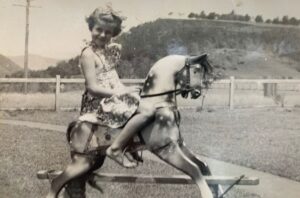
At home, Jess kept everything in working order. She would walk into town on errands, or send off the one of the girls on a bicycle. She was an average cook, and the family’s meals mostly consisted of meat and 3 veg. She always kept the house filled the house with fresh flowers, hand-picked from her garden out the front of the house. In the laundry, everything was washed by hand. The girls would help Jess wash the clothes, which they quite enjoyed, despite it being a rather drawn-out, all day ordeal. The clothes were boiled in the boiler, heated by gas, put through a hand wringer and pegged outside. A couple of times a year the blankets would be washed, and Kathy and Tricia would jump up and down on them in tubs.
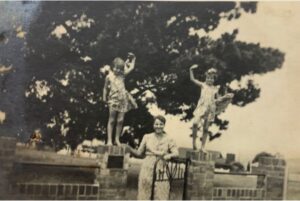
Kathy and Tricia also helped Jess sell the family’s excess vegetables, grown in Basil’s vast vegetable patch out the back of the house. Jess had a transaction arranged with the local fruit and veg merchant. Once or twice a week Kathy or Tricia would pedal into town, a basket on the front of the bicycle brimming with produce.
Tricia now says of Toowoomba that she can “only remember fifteen years of being very cold”. The house was “built for Townsville”, with no insulation or fireplace. In the cold months the family would go to bed every night wearing bed socks, pyjamas, dressing gowns, beanies and gloves, all of which they kept on as they huddled under the covers. Jess went out of her way to make home a comfortable place, despite the harsh climate. The house was somewhat warmed by a little wooden stove she had built into the kitchen. There was a settee room of sorts where the pianola lived, but no proper lounge, so the kitchen was the main living area. Everybody congregated here, to read and chat and play games such as monopoly and rummy. Jess had a countertop divider installed that split up the room in two sides for cooking and eating. On one side were a few cupboards for food and supplies, a little gas cooking stove, the wooden stove alcove and an icebox, for there were no refrigerators in those days. This was not an issue in Toowoomba, where the tap would sometimes freeze solid in the cold. The ice-man visited about three times a week with a big block of ice. He would let himself in the front door, for nobody locked their doors in Toowoomba, and the family would greet him with a friendly hello as they sat around the bench eating breakfast. At night-time they would light a fire in the little wooden stove and sit huddled around the alcove to keep warm, reading books.
Jess was very involved in community life. Everybody loved her, it was impossible not to. She was ever smiling and filled with social energy, walking about the streets of Toowoomba always open for a neighbourly chat. She ran a mail order business for country women, where she would do their grocery shopping and post the parcels out to their homes. She was a member of the Toowoomba library, and would regularly walk into the city to change her books. Jess also loved the Toowoomba Carnival of Flowers, which she’d attend with the family. The family witnessed the expansion of the carnival, from its small beginnings to become the town event of the year.
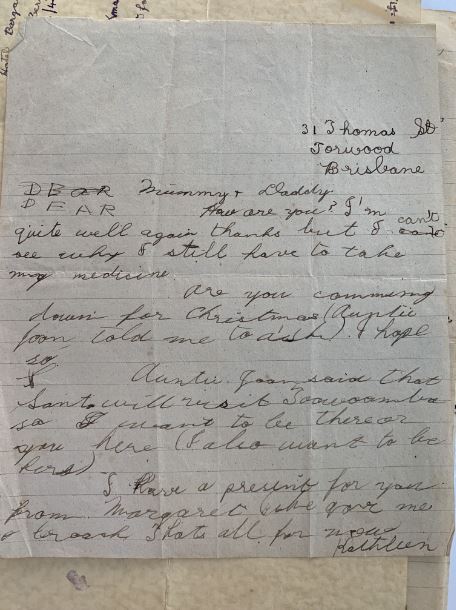
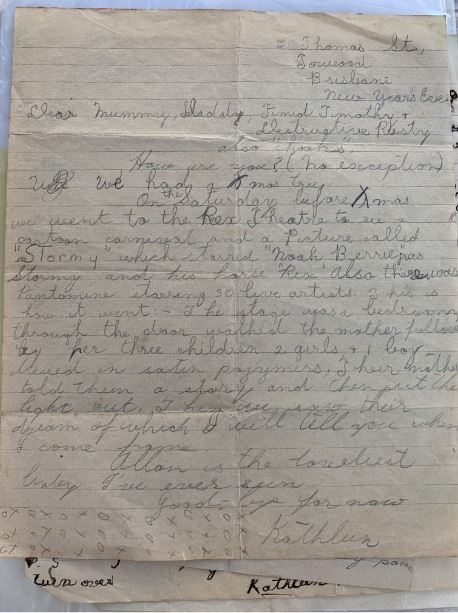
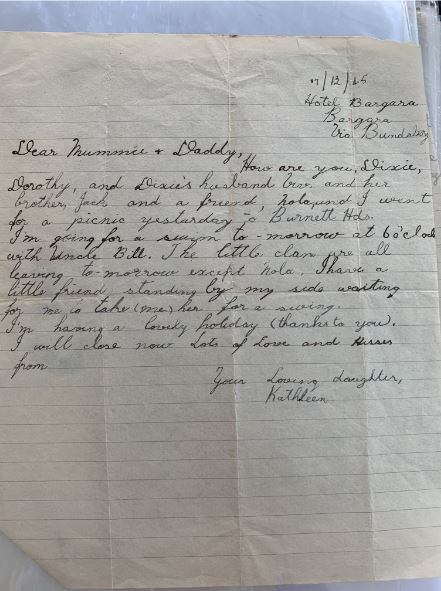
Letters from Kathleen
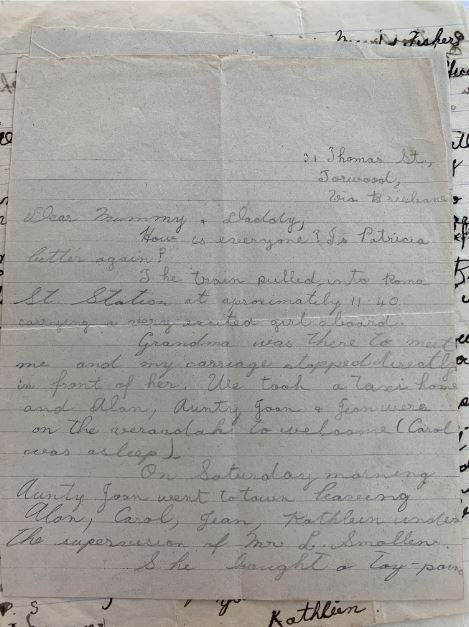
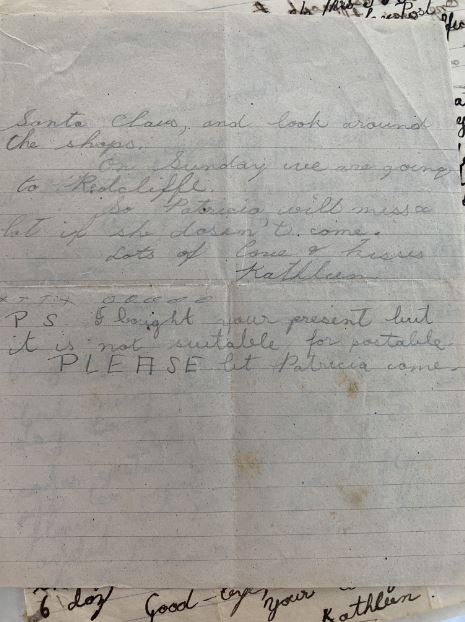
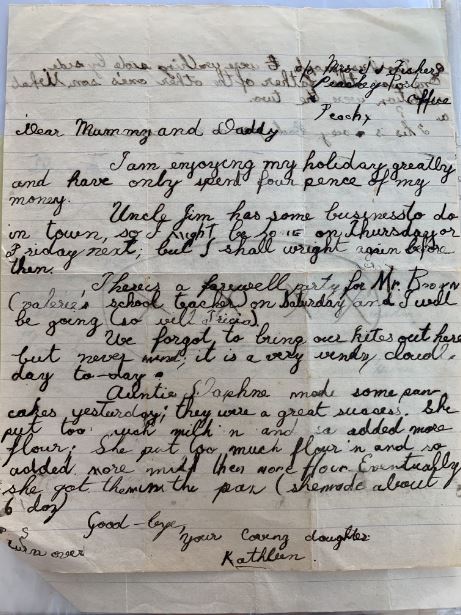
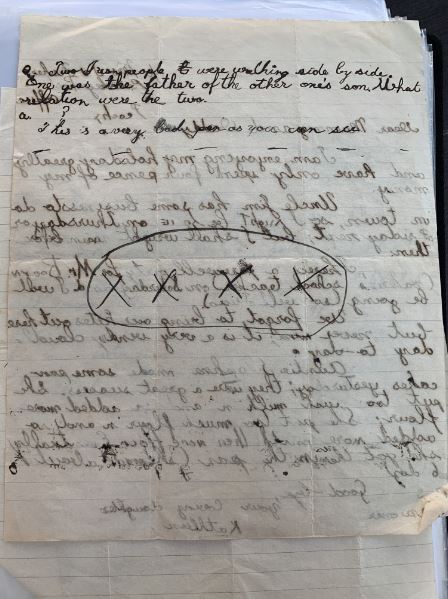
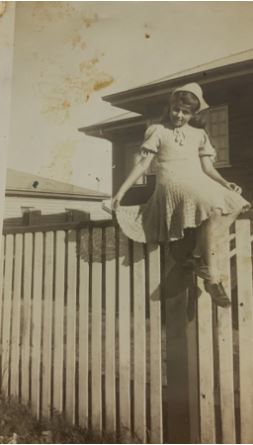
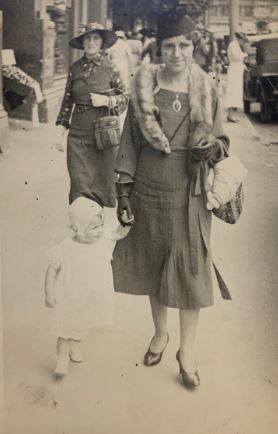
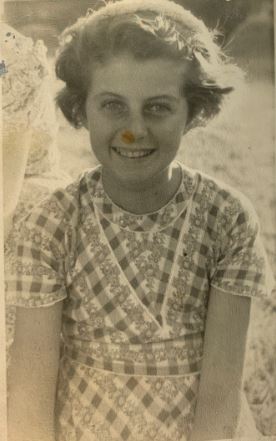
Photos
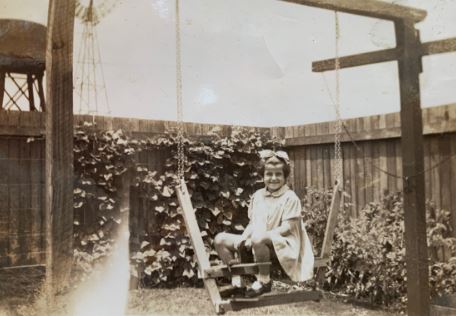
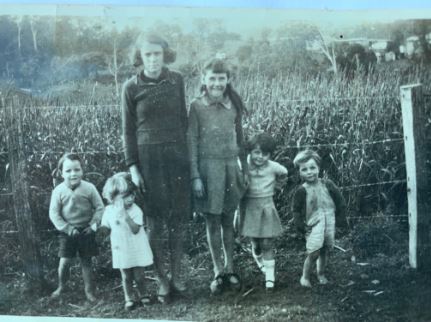
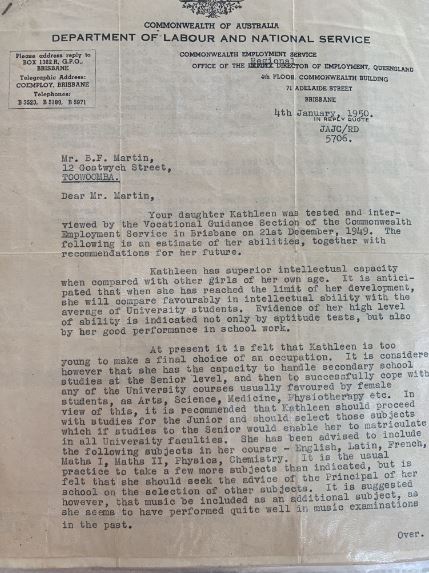
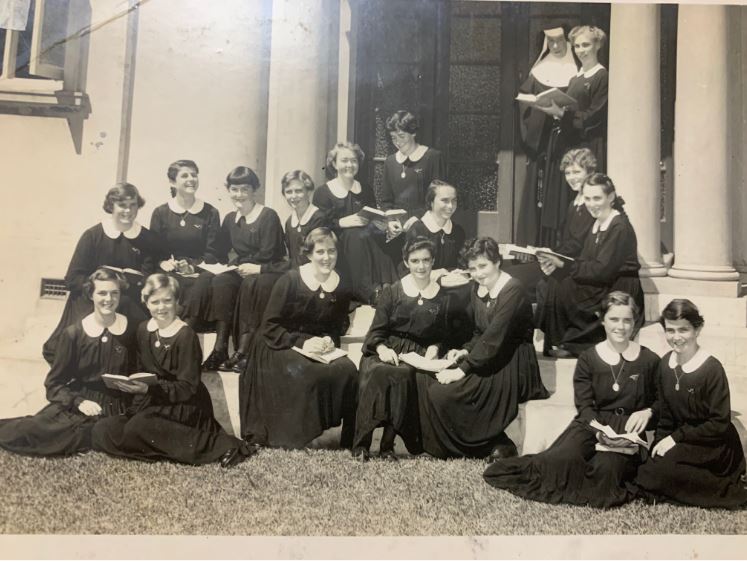
The Next Generation
Weddings
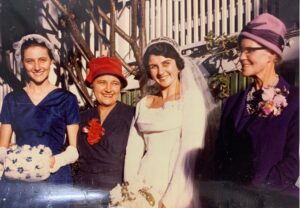
1958 was an exciting year for Jess’s family, for both of her daughters were engaged, within a few months of each other. Both daughters were living with their parents during their teacher training, at 7 Livingstone Yeerongpilly, Brisbane. Having lived apart for a few years, it was lovely for the family to be reunited now that the girls were adult young woman.
Both girls were seeing men who were, at the time, in the medical industry. For two years Tricia, Jess’s youngest, had been seeing John ___, who was in his fourth year of medicine, and had been offered a scholarship that gave him just enough money to afford marriage, provided he work in New Guinea for a couple of years after his studies. When he asked Jess and Basil for Tricia’s hand in marriage, they were concerned that she would be married before Kathy, the eldest daughter. The consensus was that it was acceptable that Tricia’s wedding take place first, provided that Kathy was the first to be engaged. Kathy was officially engaged to Warwick Parer in August, 1958, and Tricia to John a month later, in September.
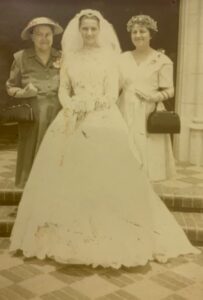
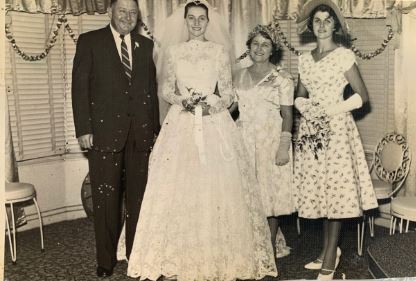
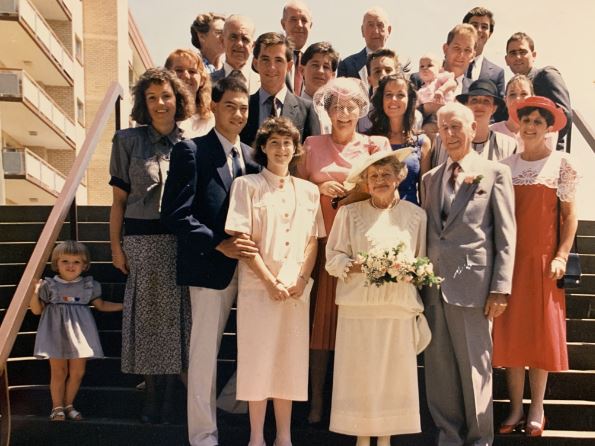
Tricia and John were married in December 1958, in a church in Annerley. The wedding reception took place in the Yeerongpilly house. Tricia wore a dress of Belgian lace, a second-hand piece from a wealthy friend of Kathy’s. Though she was resistant to wearing another woman’s wedding dress, she was advised by Jess that the gown was so rare and exquisite she would not find any others of the like. In the wedding photos, Jess had to stand on a step, so that her height would measure up to the rest of the wedding party. One particular photo features three generations of woman: Mary, Jess and Tricia as bride, with mother and grandmother both so tiny that they stand on the stairs, while Tricia stands tall in the middle.
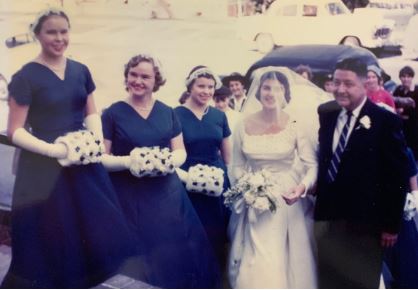
Kathleen and Warwick’s wedding was the following year, in August 1959. The couple married at St Agatha’s, the church of a school where Kathy was teaching at the time, and a student choir sang at the service. Jess sewed dresses of royal blue for the bridesmaids, with white lacy headpieces. For their honeymoon, Kathy and Warwick packed all their belongings and sailed to Melbourne, which was to be their new home. It would have been a bittersweet time for Jess, to have both daughters living at home with her and then suddenly none at all, off to begin their new married lives. Jess and Basil travelled down to Melbourne to visit Kathy once she was settled in, and stayed with their daughter and her husband a while.
Becoming a grandmother
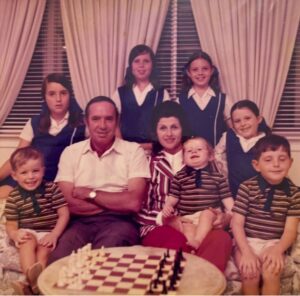
It was not long after her daughters’ marriages that Jess became a grandmother. Altogether, there were eleven grandchildren. Kathy and Warwick had seven children, the eldest of whom were born in Melbourne, where the family lived for eleven years. The first four children were all girls – Carolin, Helen, Sonya and Martine. Then there were the boys – Warwick, Justin and Rowan. Tricia and John adopted their three children while they were living in Mt Morgan – Tom, Kate and Susan.
Jess was a very active grandmother. She didn’t see Kathy’s children very often while the family were living in Melbourne, but once they moved back to Brisbane, she made sure to be present in their lives. She kept liquorice all-sorts to give them as treats, and would slip them money to go buy ice-cream at the corner store. When Kathy and Warwick won money on a racehorse they owned, Lapanda, they went travelling, and Jess was left in charge of all seven children at home. Having only been a mother to two daughters herself, this would have been a challenge. The three boys came down sick with chickenpox, and would run naked around the house to dry themselves after showering. The family had a rooster in the back garden, and when Jess went out to feed it she would be pecked all over. She would come back into the house scratched and bleeding.
It was always a joke to see what presents Jess would give everyone for Christmas and birthdays. After Basil’s death, she was living on a pension, and would acquire her gifts from St Vincent De Paul, where she worked. She would find all sorts of weird and wonderful items, and wrap them up in recycled pages from magazines.
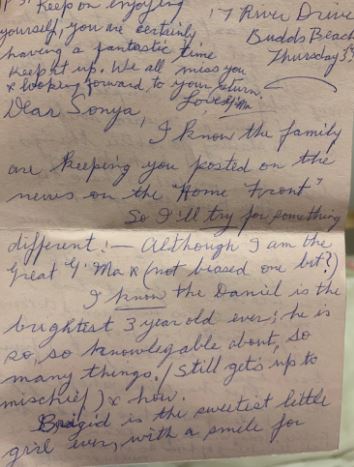
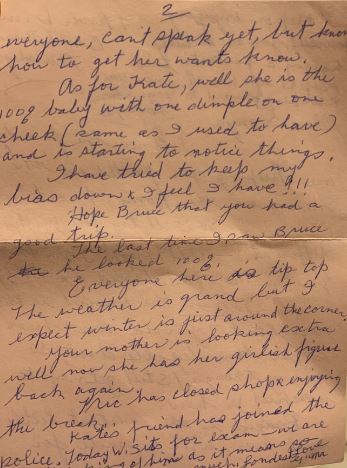
Jess eventually became a great grandmother too. Kathy’s eldest, Caroline, lived with her on the Gold Coast when she first had children, and needed somewhere to stay in the early years (see “Hosting grandchildren”). Jess wrote letters to Sonya, another of Kathy’s children, who was travelling in England and Ireland, describing Caroline’s children. “I know the family are keeping you posted on the news on the “Home Front”. So I’ll try for something different – although I am the Great G’Ma (not biased one bit?)I know that Daniel is the brightest 3 year old ever: he is so, so knowlegable about so many things. (still gets into mischief)… Brigid is the prettiest little girl ever, with a smile for everyone, can’t speak yet, but knows how to get her wants known. As for Kate, well she is the 100% baby with one dimple on one cheek (same as I used to have) and is starting to notice things. I have tried to keep my bias down and I feel I have!!!” Though she did not live long enough to meet all of them, Jess eventually would have twenty great grandchildren.
Letters to Sonya (granddaughter)
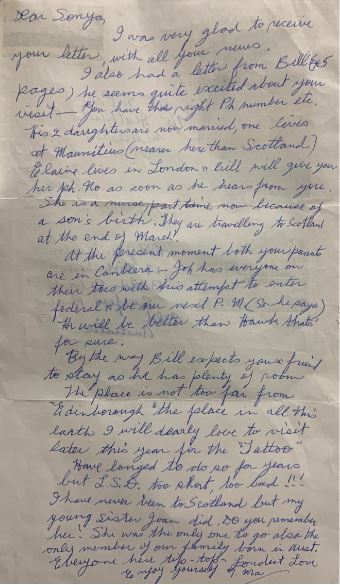
Dear Sonya,
I was very glad to receive your letter , with all your news. I also had a letter from Bill (5 pages)… he seems quite excited about your visit – you have the right ph number etc.
His 2 daughters are now married, one lives at Mauritius (nearer hear than Scotland). Elaine lives in London and Bill will give you her ph no as soon as he hears from you. She is a nurse, parttime now because of a son’s birth. They are travelling to Scotland at the end of March.
At the present moment both your parents are in Canberra – Joh has everyone on his toes with his attempt to enter federal and be our next P.M. (so he pays). He will be better than Hawk, that’s for sure.
By the way Bill expects you and friend to stay so he has plenty of room. The place is not too far from Edinburgh… the place in all this earth I will dearly love to visit later this year for the “Tattoo”. Have longed to do so for years but L.S.D. too short, too bad!!!
I have never been to Scotland but my young sister Joan did. Do you remember her? She was the only one to go also the only member of our family born in aust. Everyone here tip-top. Enjoy yourself.
Fondest love,
G. Ma
Dear Sonya,
I know the family are keeping you posted on the news on the “Home Front”. So I’ll try for something different – although I am the Great G’Ma (not biased one bit?)
I know that Daniel is the brightest 3 year old ever: he is so, so knowlegable about so many things. (Still gets into mischief) and how.
Brigid is the prettiest little girl ever, with a smile for everyone, can’t speak yet, but knows how to get her wants known.
As for Kate, well she is the 100% baby with one dimple on one cheek (same as I used to have) and is starting to notice things.
I have tried to keep my bias down and I feel I have!!!
Hope Bruce that (*and?) you had a good trip. The last time I saw Bruce he looked 100%.
Everyone here is tip top. The weather is grand but I expect winter is just around the corner. Your mother is looking extra well now she has her girlish figure back again. Mic has closed shop and enjoying the break. Kate’s friend has joined the police. Today W sits for exam – we are all thinking of him as it means so much.
Fondest love,
G,ma
P.S. Keep on enjoying your trip, you are certainly having a fantastic time. Keep it up. We all miss you and looking forward to your return.
Love, G’Ma
Dear Sonya,
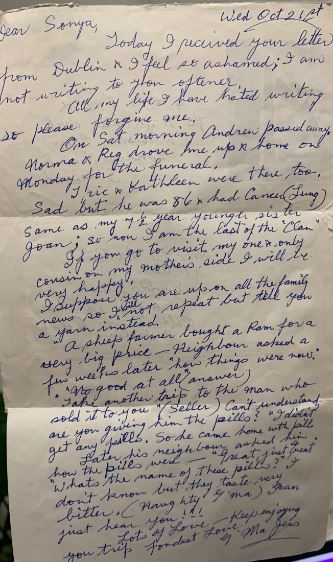
Today I received your letter from Dublin and I feel so ashamed I am not writing to you oftener. All my life I have hated writing so please forgive me.
On Sat morning Andrew passed away. Norma and Reg drove me up and home on Monday for the funeral. Tric and Kathleen were there too. Sad but he was 86 and had cancer (lung) same as my 7 ½ year younger sister Joan: so now I am the last of the “clan”. If you go to visit my one and only cousin on my mother’s side I will be very happy.
I suppose you are up on all the family news so I will not repeat but tell you a yarn instead.
A sheep farmer bought a ram for a very big price – neighbour asked a few weeks later “how things were now”.
“no good at all” (answer) v.
“take another trip to the man who sold it to you”
(seller) “Can’t understand, are you giving me the pills?”
“I didn’t get any pills.” So he came home with pills.
Later his neighbour asked him how the pills were – “great just great”
“what’s the name of these pills?”
“I don’t know but they taste very bitter. (Naughty G’Ma). Jean (??) just hear you!!!
Lots of love – Keep enjoying your trip.
Fondest love,
G’Ma Jess
Photos
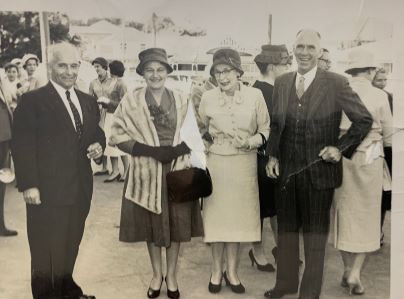
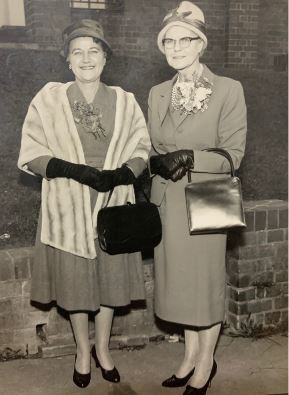
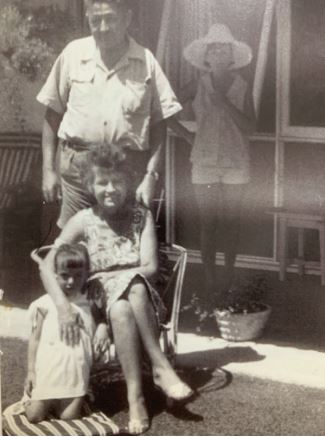
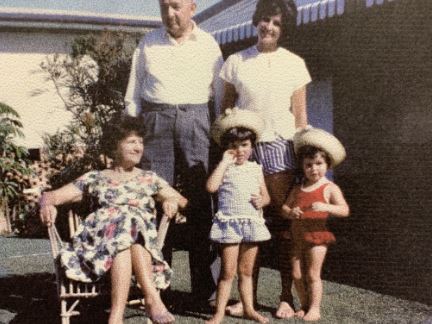
Budd’s Beach
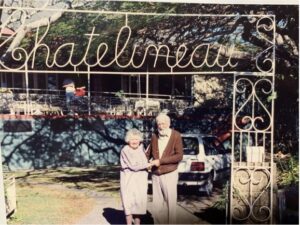
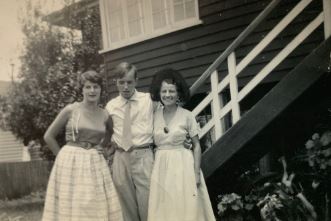
After the death of her first husband, Basil Martin, it was not long before Jess moved into a house at Budd’s Beach. The house was bought by Kathy and Warwick, intended as a holiday home, and also as somewhere for Jess and Basil to stay, before Basil became ill. Jess spent many years here towards the end of her life – it was the last actual house that she made her home. The property still belongs to the family today, its name of “Chatelineau” written in cursive white letters over the driveway. It is right next to a river, with a little bay to go swimming.
Hosting grandchildren
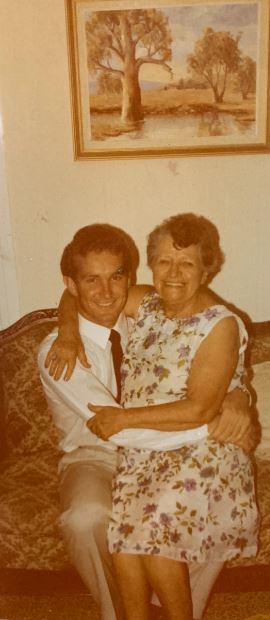
Multiple grandchildren came to Budds Beach to live with Jess, for various stretches of time. As the house belonged to Kathy, she offered the spare rooms to her children when they needed somewhere to stay. Jess was welcoming and generous with her space, and was likely also grateful for the company. Though she was lively and still very capable of looking after herself, she was living alone for the first time in her life.
Carolin and her husband Peter lived with Jess for three years, from 1984 to 1987. The couple had three young children, and so the house was often filled with the sound of babies crying, and the general chaos of family. If the noise was disturbing to Jess, she didn’t let on. She was flexible with her routine, happy to babysit if the parents wanted to go out for some time to themselves. Carolin and Peter would do most of the grocery shopping. It was likely this was a great relief for Jess, for she was living on a pension, and didn’t have much money to spare. She would go out to collect some of her own supplies, including offal meat such as tongue and brains and tripe, which she would press on the kitchen counter. The generational gap was very clear here to her granddaughter, Carolin, who didn’t understand the appeal of eating all parts of the animal. Jess also cooked everything in deep layers of fat. Eventually a system was worked out where Carolin was in charge of cooking, and Jess instead did all the cleaning.
Jess very much enjoyed the company of young people. Carolin and Peter were only 24, and would often have their young friends around for dinners or drinks on the veranda. The house had a huge veranda out the front where guests would congregate, and Jess would perch outside with a glass of white wine, refusing to shift. She loved to tell all sorts of stories, and would often refashion the truth to suit her tale. She would tell dirty jokes, which she seemed to have an infinite supply of. She was a flirt, even in her old age, and especially liked to chat to the young men. Even with her grandchildren she was often softer on the boys. Perhaps this was related to her absent father as a young girl, or because she had never had a son of her own.
Carolin and Peter left after Jess remarried, finding themselves a coastal house of their own. As a thank you present to Kathy and Warwick, and also to Jess, they had the house repainted in heritage colours of green and red. After Carolin, a few other grandchildren came to stay, including Warwick and Justin. Warwick especially found his time with Jess very impactful, and he always expressed great admiration for the gusto with which she gave herself to life.
Spritely as can be
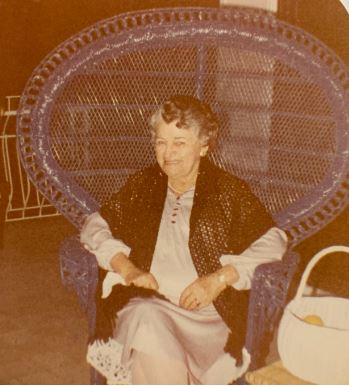
Even in her old age, Jess seemed to have an infinite supply of energy. She was still little and feisty, with sparkly, smiling blue eyes. She would swim in the river near the beach house all year long, even in winter. She would take herself out for walks, up and down the street. One day, she stumbled upon a man trying to rob the house and she shooed him away, running at him like a crazy woman.
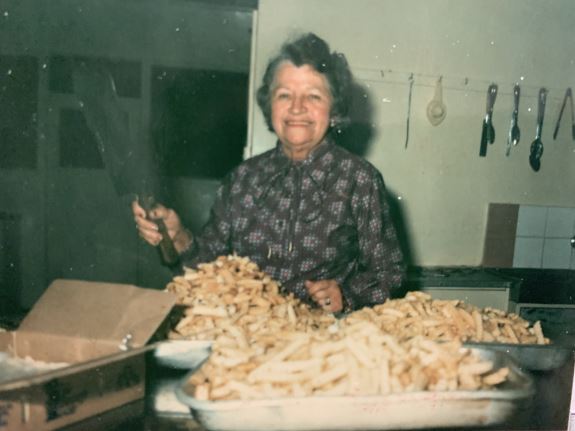
Despite her past distaste for alcohol, Jess enjoyed a drink. She particularly liked white wine, and kept a carafe in the fridge. When her granddaughter Carolin was staying at the house with her husband and children, the family was were bemused by this carafe, as it never seemed to change levels. Every night, Jess would have a glass of white wine with dinner, and every morning the carafe would still contain the same amount of wine. One day Carolin’s husband, Peter, was assisting Jess with a task in her bedroom, and had to access underneath her bed. Littered all over the floor were empty wine flasks, hidden away. Though she had discovered the joy of a civilised glass of alcohol, Jess still held onto to a certain level of shame around drinking, inherited from her era.
Jess never had a day at home, and would go out to socialise. She played bowls and solo, and worked at St Vincent de Paul. She also worked for the local jeweller, mending jewellery and repairing chipped china. She was always out in the front garden of the beach house, which was quite public, and she would say hello to everyone walking past, chatting to neighbours. Everybody knew Jess. She was a well-loved member of the community.
She made sure to always stay up to date with family news, and liked to be involved in others’ lives. She stayed up to date with world news too, reading the paper on a regular basis. She liked reading magazines, and when she was done with them she fold the pages and turn them into fans, or would recycle the pages as wrapping paper. Jess’s creative streak meant that she always had something to do. She would cut up old bread wrappers and turn them into coat-hanger covers. She adored contact paper, and would decorate cupboards and drawers by sticking on various colourful patterns.
But despite all her constant activity and energy, Jess was still ageing. She had dentures, having had all of her teeth removed. She also had diverticular disease, a bowel disorder, which caused to her weight to go through quite dramatic fluctuations. Sometimes her condition would cause her a lot of pain, and she’d disappear to bed for a few days. She never complained, always picking herself back up and throwing herself into everyday activities. It was likely this determination that allowed her to live to such an old age.
St Vincent De Paul
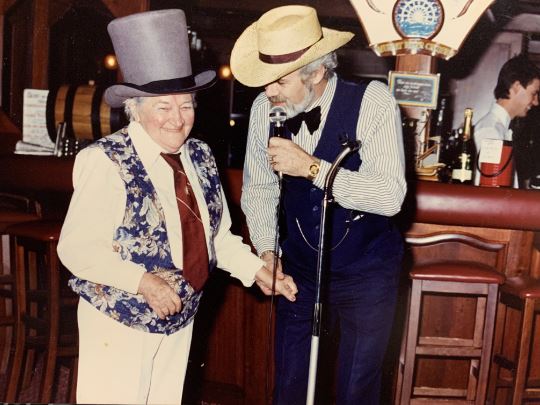
While she was living at Budd’s Beach, Jess spent many years working at St Vincent De Paul. This was the perfect workplace for Jess, who held a life-long determination to waste as little as possible. She adored clutter and trinkets, and would fill her house with all sorts of odd objects she’d collected from the store. She would hoard items for a while, and then grow sick of them, returning them to St Vincent De Paul and buying herself a new set of clutter.
Her family also reaped the benefits of her job. She would buy second-hand finds as presents for Christmas and birthdays, often to the bemusement of their recipients. She would also visit with bags of clothes for the grandchildren, who grew up on wardrobes from St Vincent De Paul. When they grew out of the clothes, Jess would bring them back to the store and come back with a new collection of things to try on.
It was also while she was working at St Vincent De Paul that Jess met John Evans, her second husband.
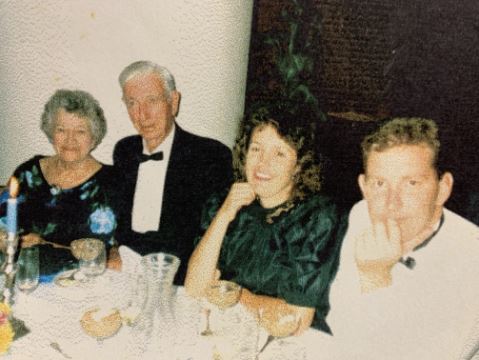
Marriage to John
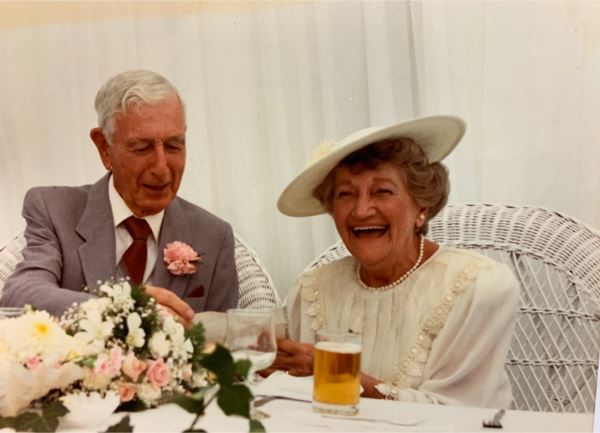
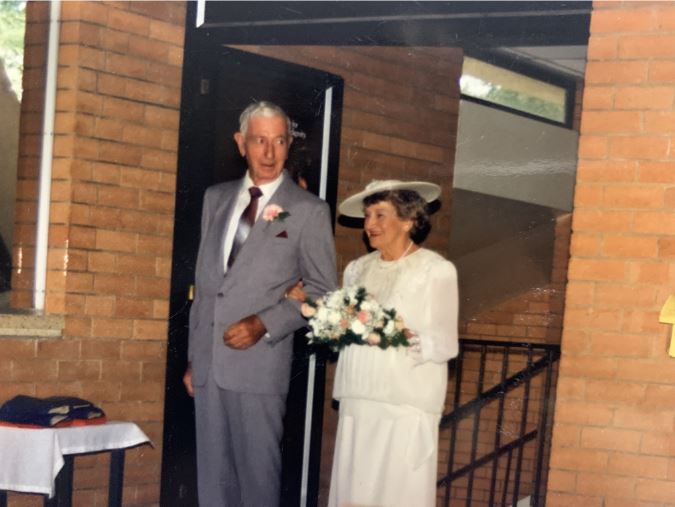
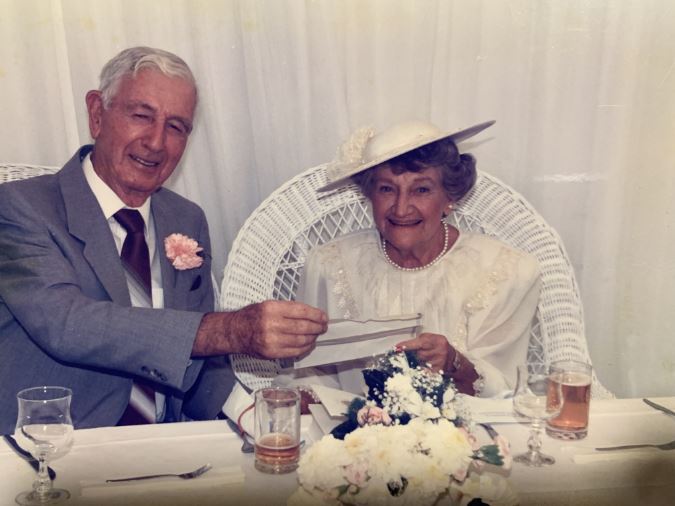
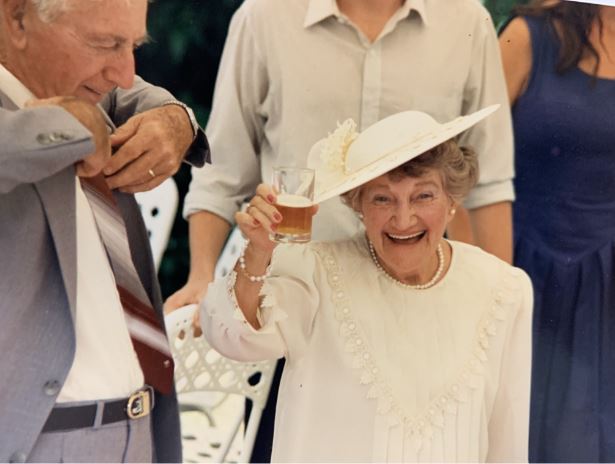
Jess met John Evans while they were both working at St Vincent De Paul. Their relationship was a secret for a while, until one day Jess approached her son-in-law, Peter, and said “I’m thinking of getting married but I’m thinking of eloping – what do you think?” She did not elope, and married John at a small family wedding in 1988, at the age of 83. Jess, who was always very dress proud, had much consternation about her wedding dress. Both Jess and John were widowed, and she felt it wasn’t right to wear white again at her second wedding. She chose cream, instead, paired with a lovely hat. Carolin and her family moved out of the beach house before the wedding, to give the newlyweds their privacy.
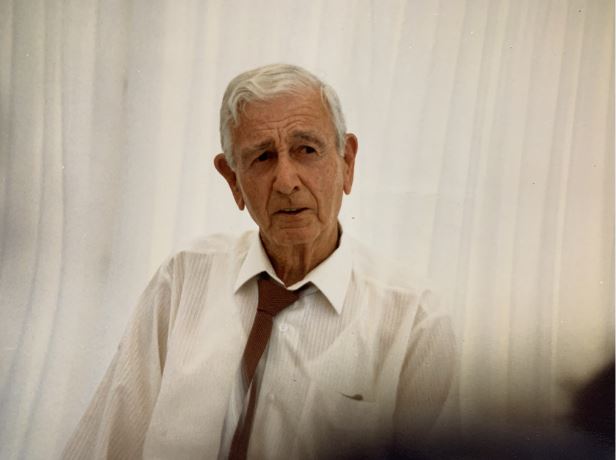
John was described by all as a “lovely” man. He could recite the entirety of The Man from Snowy River by Banjo Paterson, and did so on their wedding day. Around John, Jess became a teenager again, blushing and batting her eyelids. They both had a devilish streak. John, who had been a teacher in his younger years, told stories of the illegal booking agency he used to run in his back garden. With a large family of nine children, and only a humble teacher’s salary, it had been a strategy to earn some extra income. Whenever the police were near the children would stuff the chips into tennis balls and roll them away into the back of the garden.
Jess and John also had a shared love of driving, even though neither of them were very skilled on the road. Jess was very excited when she bought herself a yellow Suzuki, and would drive about in her tiny car, savouring her independence. John was aware of his questionable driving, but didn’t let it phase him. Jess’s grandson, Justin, recalls asking him how his drive over to the house was, to which John replied “oh pretty good. Only five people beeped at me.”
Jess and John were very much in love, for the seven to eight years they shared. In their first year of marriage, John and Jess spent Valentine’s Day at the Aquatic and Yacht Club at Tweed Heads, NSW. “A great day it was too with entertainment etc.” recorded Jess, “as usual we both played the ‘Pokies’ and as usual we both did our dough.” John won a box of chocolates, receiving first prize in a romantic poetry competition. His poem read:
To Jess,
The times when we’re together
Mean more than I can say.
I hope it can be forever, cause
I love you more each day.
Yours John. 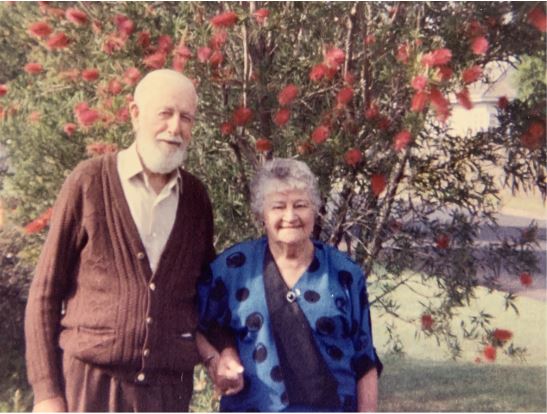
After Valentine’s Day, a newspaper article was published featuring a smiling photo of John and Jess. “Another couple holding hands and browsing through the shops were John and Jess Evans, of Budds Beach. “We are too old for all that,” said John. “We are both 83. This will be our first celebration of Valentine’s Day together.” John said their secret is to tell each other ‘I love you’ every day.”
John and Jess eventually moved out of the Budds Beach house and into a retirement village. It was walking distance to church, and food was all supplied, so there was no need for them to drive anywhere. They made the most of their elderly years, playing bingo and going on bus trip tours organised by the retirement village. When Jess developed Alzheimer’s, John would cover for her, knowing that she wouldn’t want any sign of weakness to be exposed. John died suddenly, a couple of years before Jess.
End of Life
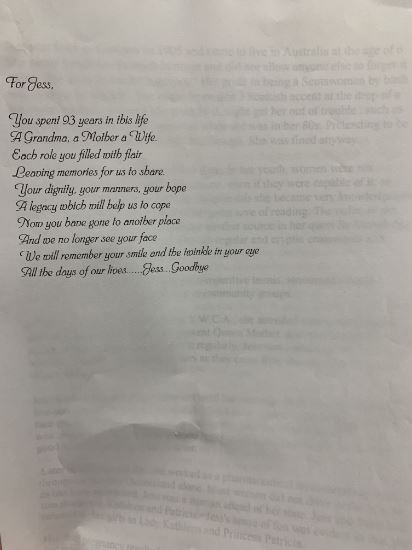
After the death of her second husband, Jess moved to a Brisbane facility, to be closer to family. She was suffering from quite severe Alzheimer’s by the end of her life, and had grown old very fast. She eventually passed away on the 3rd of August, 1998, at the age of 93. She was cremated, and her funeral took place at the Regina Caeli Catholic Church.
Jessie’s garden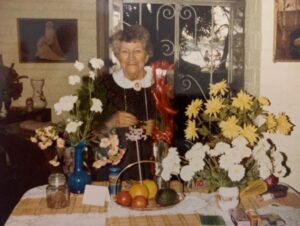
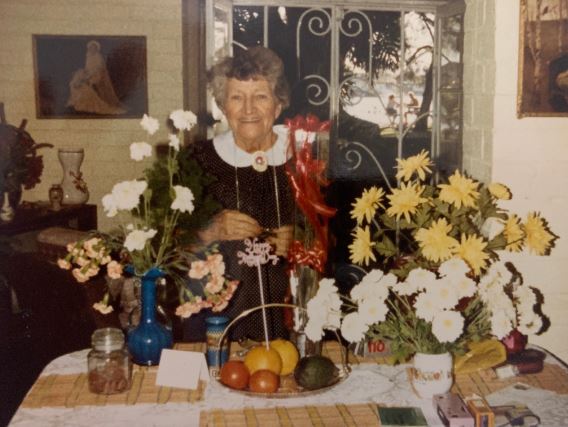
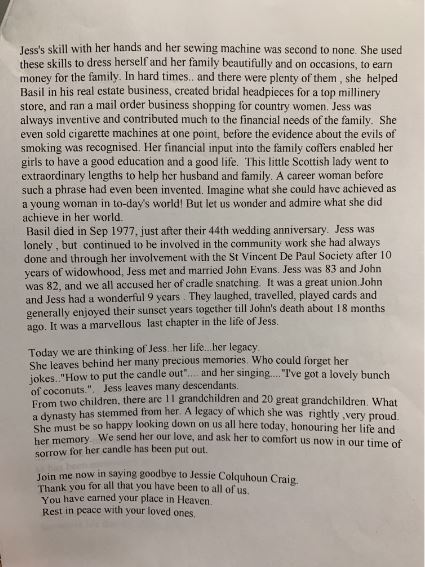
All of her life Jess adored gardening. She loved to be outside, with her hands in the soil. Her first husband, Basil Martin, shared her passion. At their family house in Toowoomba, the front garden was Jess’s region and the back garden belonged to Basil. Basil had a vast vegetable patch, where he at one time claimed to grow 57 different vegetables, including three variations of lettuce. The family ate fresh, home-grown produce, and would sell their excess vegetables to the local grocery. Jess grew flowers, and the front of the house was lined with gerberas and daffodils. She eventually ran out of room.
The couple continued to nurture their garden in Brisbane, and again when they moved to Stoke Lane. It was here that Jess grew lush ferns, that she would sell to the local nursery and florist. They would buy these ferns to be the greenery in bouquets of flowers, and she managed to earn quite a significant income.
At Budd’s Beach, in her old age, Jess continued to spend hours out in the soil. She kept a very busy garden, with all sorts of flowers and species growing here and there. The garden itself was very public, and it was a common neighbourhood sight to see Jess out in the sun, digging and snipping and watering.
Sewing
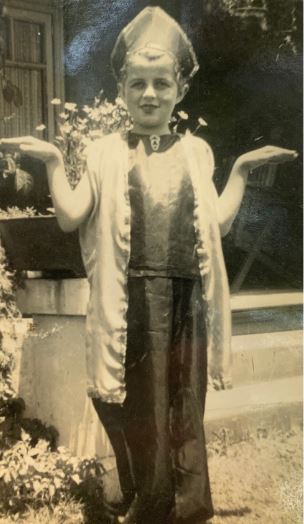
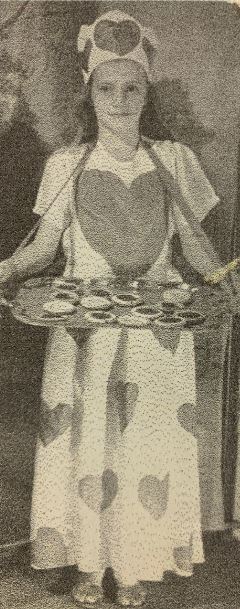
Jess was a master seamstress. In her Toowoomba family home, there was a sewing machine, sitting in a room of its own. Here she would spend hours, making all of her own clothes, and the family’s clothes too. This would have been a money efficient system, for a family of humble financial means, but Jess also did find a lot of pleasure in the task. She enjoyed the meditative aspect of sewing, and the satisfaction of making something from scratch. She sewed white lacy dresses for Kathy and Tricia for their holy communion, and would always make them costumes for fancy dress balls at school. She assisted the nuns at Kathy’s boarding school by mending uniforms. She also ran a business to help country women buy the supplies they needed from town (see “An Entrepreneur”), which included purchasing and sewing curtain material. Her own house was filled with colourful, homemade cushion covers and curtain and quilts.
When she moved back to Brisbane, she worked for a well-known millinery store in the city, sewing bridal headpieces. She made the bridesmaid dresses for her eldest daughter’s wedding. She was much admired by Kathy and Tricia, who both claim their mother could “sew anything.”
An Entrepreneur
The legacy of Jess’s financially tight childhood instilled in her a lifelong awareness of money. She was never wealthy, but always found a way to make ends meet. Her many years working for various pharmacies gave her a sense of business to fall back on, and a consistent work ethic. Her capacity to find new, creative ways to earn extra income was never-ending.
In Toowoomba, Jess applied her business sense to helping out her husband’s real estate agency, managing paperwork and finances, but she also had a few entrepreneurial side projects. She ran a mail order business for country women who lived too far out to run errands in town, and would do their grocery shopping, as well as buying curtain material and other such goods to send out to their homes. She also sold the family’s excess vegetables, setting up a transaction with the local grocer. And she helped out at the St Ursula’s boarding school to supplement her daughters’ school fees, mending uniforms and driving students to appointments.
In later years, when she moved back to Brisbane, she sewed millinery for a bridal store in the city, and had a temporary stretch in the business of selling cigarette machines. When she lived at Stoke Lane, she sold ferns to the local plant nursery and florist, which became the greenery in flower bouquets. Even in her old age she continued to find extra sources of income. During her years at Budds Beach, she repaired china. She would sit at a table with all her glues and paints spread before her, holding pieces together for long stretches of time, waiting for the glue to set. She would then repaint the ceramics in the same colours as before, with an acute attention to detail. She also was paid by the local jeweller to mend broken jewellery. The diversity of occupations she found for herself is suggestive of Jess’s constant curiosity and willingness to try new things, as well as a confidence in her skills. She was restless, and always wanted to be doing something useful.
Favourite Memories and Quotes
From Carolin, granddaughter
“In another life, she’d have been quite a career woman. She was very industrious, and was so interested in everything.”
“She was very lively and active and dynamo and full of energy.”
“She was always pottering, always pottering. I can’t even remember her watching TV.”
“I don’t know that she was a particularly good driver, but she liked driving. Because of the independence it gave her I think. She had this tiny little car, I think it’s good it was yellow – people could see it coming and get out of its way.”
From Justin, grandson
Talking about Jess cooking with fat…
“I remember that lard jar…it was yellow. And it had small rings and the rings got bigger, and as you got into it, it was like going through history, there’s different layers of old bits of fat sitting there. And she’d take a big dollop right from the bottom and we’d just be sitting there going “oh.. god. Dinner’s up!”